What Cebuanos, Developers, Contractors and Government Can Do to Prevent the Next Major Flood
Cebu is growing rapidly.
New subdivisions, roads, commercial developments, resorts, houses and other projects are transforming both the urban areas and the mountain slopes surrounding Metro Cebu and other parts of the province.
Development brings jobs, investment and better living—but it also creates an important question that every Cebuano should be asking:
Can Cebu continue developing its mountains and watersheds without increasing the risk of catastrophic flooding downstream?
The question became particularly relevant after the devastating flooding experienced by Cebu during Typhoon Tino in November 2025. Since then, the provincial and national governments have accelerated flood-control planning, river rehabilitation, drainage projects, watershed management and proposed dam projects.
This does not mean Cebu is destined for another catastrophic flood.
But it does mean that flood resilience must become part of the way Cebu plans, designs and constructs its future.
For homeowners, developers, contractors and government alike, the goal should not be to stop development.
The goal should be:
Build Cebu—but build it in a way that does not turn the mountains into a funnel for floodwater.
Why Mountain Development Matters
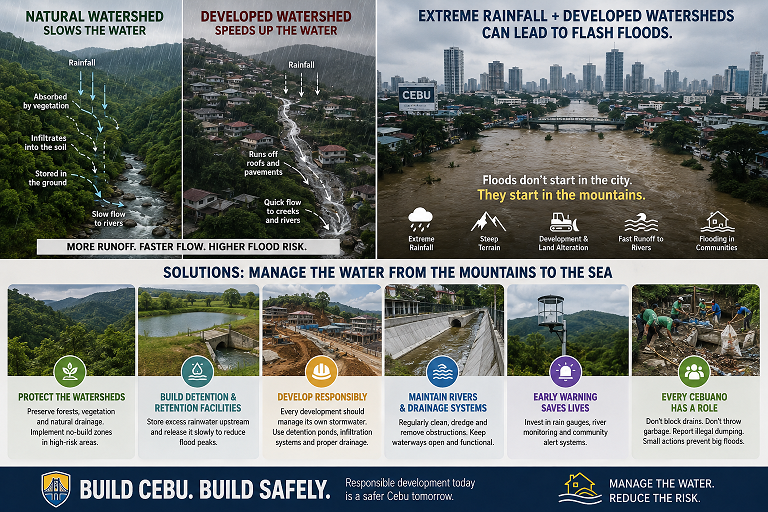
A natural watershed performs an important job.
When rain falls on a forested or vegetated mountain:
- some water is absorbed by vegetation;
- some infiltrates into the soil;
- some enters groundwater;
- some is temporarily stored in the ground;
- and the remainder gradually flows into creeks and rivers.
This slows the movement of water.
Now replace portions of that landscape with:
- concrete roads;
- roofs;
- parking areas;
- paved driveways;
- buildings;
- drainage pipes;
- retaining walls; and
- other impermeable surfaces.
Much more rainwater can become surface runoff.
Instead of:
Rain → soil → infiltration → slow runoff → river
the system can become:
Rain → roof/road/concrete → drainage → creek → river
The result can be a much faster concentration of stormwater.
This is why a development does not have to be located beside a river to affect flooding.
A project several kilometers upstream can potentially contribute to downstream flooding if it significantly changes the amount and timing of water leaving its site.
This does not mean that every mountain development causes flooding. Determining the actual impact requires proper hydrological and engineering analysis.
But the principle is important:
The way Cebu manages its upper watersheds can directly affect the safety of communities downstream.
Cebu’s Mountains Are Part of Its Flood-Control System
Cebu’s mountains should not be viewed simply as land available for development.
They are also part of the island’s natural water-management system.
Forests, vegetation, soil, natural drainage channels, wetlands and other natural features all contribute to managing rainfall.
When these systems are disturbed, engineering must compensate for some of the lost natural capacity.
This is why responsible hillside development should begin with a simple question:
Where will all the rainwater go?
Not just during an ordinary rain—but during an extreme rainfall event.
Could Cebu Experience a Major Flash Flood?
Yes.
Cebu cannot eliminate the possibility of severe flooding.
The province is exposed to tropical storms and intense rainfall, while many communities are located downstream from steep watersheds.
A particularly intense storm can produce an enormous volume of water within a short period.
The danger becomes greater when several factors occur simultaneously:
Extreme rainfall + steep terrain + saturated ground + altered drainage + reduced infiltration + river bottlenecks + inadequate downstream capacity
A flash flood can develop rapidly when water from numerous mountain tributaries converges into a river system.
The situation can become even more dangerous if a landslide or debris blockage temporarily obstructs a creek or river.
When that obstruction fails, water, mud, rocks, trees and other debris can move downstream extremely quickly.
This is different from the mechanism behind a Himalayan glacier or ice-and-rock disaster.
Cebu does not have that particular hazard.
But Cebu does have its own potentially dangerous combination:
steep watersheds + intense tropical rainfall + development + altered drainage.
That combination deserves serious attention.
Cebu Is Already Taking Action
The good news is that Cebu is not ignoring the problem.
In 2026, the Cebu Provincial Government has been pursuing a much more integrated approach to flood management.
The Metro Cebu Flood Control and Drainage System Implementation Task Force is working on coordinated flood mitigation involving multiple LGUs and national agencies.
The proposed measures include:
- river and revetment works;
- diversion channels;
- drainage improvements;
- flow-control systems;
- dams;
- retention basins;
- lagoons;
- recharge areas;
- infiltration beds;
- rainwater harvesting; and
- water-storage systems.
This is important because flood control cannot be solved by one municipality working independently.
Water does not stop at political boundaries.
Rain falling in an upper watershed can eventually affect communities many kilometers downstream.
Cebu’s Proposed Dam Projects
One of the major initiatives now being pursued is the development of dams or major water-impounding structures along Cebu’s major river systems.
The proposed locations include river systems associated with:
- Mananga;
- Bulacao;
- Guadalupe;
- Kinalumsan;
- Lusaran;
- Butuanon;
- Cansaga;
- Cotcot; and
- Danao.
The provincial government has reported a national government commitment of approximately ₱8 billion toward the proposed dam program.
The objective is not simply water supply. Properly designed impounding structures can also help capture and regulate stormwater and reduce the velocity of flood flows.
These projects are important—but dams alone will not solve Cebu’s flooding problem.
Cebu needs flood management from the mountain watershed all the way to the coast.
Smaller Retention Structures Are Equally Important
Not every flood-control solution needs to be a massive dam.
One of the most effective strategies can be to create many smaller places where water can temporarily stop.
These can include:
Detention ponds
Temporarily hold stormwater and release it gradually.
Retention basins
Store water for longer periods and can potentially provide additional water-management benefits.
Infiltration basins
Allow suitable stormwater to infiltrate into the ground.
Recharge areas
Help replenish groundwater where geological and environmental conditions permit.
Check dams and Sabo-type structures
Small structures in appropriate mountain channels can slow water and trap sediment, rocks and debris.
Rainwater harvesting
Capture water at the building or property level instead of sending everything immediately into the drainage network.
The province’s current flood-control planning specifically includes retention basins, lagoons, recharge areas, infiltration beds and rainwater harvesting alongside major infrastructure.
This is the right direction.
Every New Development Should Help Manage Its Own Water
This should become one of the most important principles of Cebu construction.
When a property is developed, the developer should not simply ask:
“How do we drain this property?”
The better question is:
“How do we develop this property without creating a larger flood problem for everyone downstream?”
A properly designed project should consider:
- existing natural drainage;
- watershed characteristics;
- soil infiltration;
- slope;
- rainfall intensity;
- existing downstream drainage capacity;
- stormwater detention;
- erosion control;
- sediment control;
- overflow routes; and
- emergency conditions.
The objective should be to control the peak discharge leaving the property.
In simple terms:
Don’t allow a newly developed property to turn a slow-moving rainfall event into a concentrated torrent flowing toward the next community.
What Responsible Mountain Development Should Include
Hillside construction is possible.
But it requires more engineering discipline than building on relatively flat ground.
A responsible hillside project should consider:
1. Hydrological assessment
Determine how rainfall currently moves through the property and how construction will change that movement.
2. Proper stormwater drainage
Drainage should be designed for the site’s watershed and appropriate rainfall events—not simply based on convenience.
3. Detention or retention
Where necessary, provide storage so stormwater is released gradually.
4. Slope stabilization
Cut slopes, fills and retaining structures must be properly designed.
5. Erosion and sediment control
Loose soil from construction sites can enter creeks and drainage channels and reduce their effective capacity.
6. Protection of natural waterways
Natural drainage channels should not simply be blocked, filled or redirected without proper engineering and regulatory approval.
7. Minimize unnecessary concrete
Where appropriate, permeable or less-impervious surfaces can reduce runoff.
8. Preserve vegetation
Existing trees and vegetation can help reduce erosion and improve infiltration.
9. Provide safe overflow routes
Extreme storms can exceed the capacity of even well-designed drainage systems.
A project should therefore have a planned and safe route for exceptional overflow.
10. Maintain the system
A drainage system that is full of sediment, garbage or vegetation is not the same drainage system that was designed on paper.
Construction Sites Have a Special Responsibility
Flood risk can increase temporarily during construction.
Before a project is completed, the site may have:
- exposed soil;
- newly cut slopes;
- unfinished drainage;
- temporary roads;
- stockpiled materials;
- construction debris; and
- incomplete erosion-control measures.
A major storm during this stage can wash enormous quantities of soil into downstream waterways.
Contractors should therefore implement proper:
- silt traps;
- sediment basins;
- temporary drainage;
- slope protection;
- erosion-control measures;
- construction-site housekeeping; and
- storm preparation procedures.
Good construction management is not merely about completing the building.
It is also about protecting the surrounding community while the building is being constructed.
Cebu Must Protect Its Remaining Watersheds
Engineering alone cannot replace every function of a healthy watershed.
Cebu should continue strengthening the protection of environmentally sensitive and high-risk mountain areas.
This includes:
- watershed protection;
- reforestation;
- protection of important vegetation;
- enforcement of no-build areas where appropriate;
- flood-hazard zoning;
- landslide-risk assessment;
- regulation of quarrying;
- protection of natural waterways; and
- careful land-use planning.
Cebu’s Executive Order No. 75 on flood resilience has been praised by DENR for incorporating integrated water-resource management, flood-hazard zoning, no-build zones, nature restoration and early-warning systems.
That represents an important shift toward treating flood control as a land-use and watershed-management problem, rather than simply a concrete infrastructure problem.
Quarrying and Mountain Excavation Also Need Careful Control
Quarrying and large-scale excavation can alter slopes, drainage patterns and erosion rates.
Cebu has already strengthened requirements for quarry permit holders, including tree planting and adequate drainage systems within project sites.
The provincial government has linked these measures to concerns about flooding, soil erosion and landslides.
The principle should be simple:
If an activity changes the mountain, it must also account for what happens to the water and sediment afterward.
Rivers Must Be Kept Open and Functional
Upstream management is essential—but downstream waterways must also be maintained.
Cebu has already undertaken extensive clearing and rehabilitation of waterways, including dredging, removal of waste and obstructions, and clearing of illegal structures.
Major waterways being addressed include portions of the:
- Butuanon River;
- Subangdaku River;
- Kinalumsan River;
- Guadalupe River;
- Mananga River;
- Cotcot River; and
- Cansaga system.
This work needs to continue.
But dredging and clearing should not be viewed as a permanent substitute for watershed management.
If a watershed continually sends excessive runoff and sediment downstream, the same problem can return.
Drainage Maintenance Is One of the Simplest Things We Can Do
Some flood-control measures require billions of pesos.
Others require something much simpler:
maintenance.
Before and during storm season, LGUs and communities should make sure that:
- drainage canals are clear;
- culverts are unobstructed;
- bridges are free from accumulated debris;
- creeks are not blocked;
- flood-control structures are inspected;
- pumps are operational;
- detention ponds have available capacity;
- illegal dumping is controlled; and
- construction materials are not obstructing drainage routes.
A drainage system cannot perform at its design capacity if it is filled with garbage and sediment.
Cebu’s government has also been repairing flood-control infrastructure damaged by Typhoon Tino, with the national government directing accelerated work ahead of the rainy season.
We Also Need Better Flood Warning Systems
Even the best infrastructure cannot guarantee that flooding will never happen.
There will always be storms capable of exceeding the design capacity of some structures.
That is why Cebu needs strong early-warning systems.
Imagine a network in which:
Mountain rain gauge
↓
Upper-watershed monitoring
↓
River-level monitoring
↓
Automatic warning threshold
↓
Barangay alert
↓
Evacuation
This can give communities downstream precious time to act.
Cebu’s flood-resilience policy already includes early-warning systems as one of its components.
The challenge is to make those systems comprehensive, reliable and operational before the next extreme rainfall event.
What Homeowners Can Do
Flood prevention is not only the government’s responsibility.
Homeowners can also help.
Keep drains clear
Do not allow leaves, garbage and sediment to block drainage.
Install rainwater collection where practical
Rainwater tanks can reduce the amount of water immediately entering the drainage system.
Avoid blocking natural drainage
Never fill or obstruct a natural watercourse without proper engineering and approvals.
Control runoff from your property
Don’t simply redirect all roof and surface water toward a neighbor or lower property.
Protect exposed soil
If you are building or renovating, prevent soil from washing into streets and waterways.
Don’t throw garbage into canals
A single plastic bag may seem insignificant. Thousands of pieces of garbage blocking a drainage system during a storm are not.
What Developers Should Do
Developers have an even greater responsibility because large projects can alter entire portions of a watershed.
Before developing a property, developers should ask:
Where does the water go today?
Where will it go after construction?
How much additional runoff will the project generate?
Can the downstream drainage system handle it?
What happens during an extreme storm?
What happens if the drainage system becomes blocked?
Where will excess water safely overflow?
Will the project increase erosion or sediment movement?
Will it affect communities downstream?
These questions should be answered during planning—not after the first major flood.
What Contractors Can Do
Contractors are often the people who turn engineering plans into physical reality.
That gives the construction industry an important role in flood resilience.
A good contractor should understand that:
A drainage system is part of the structure—not an afterthought.
Proper construction should include:
- correct drainage slopes;
- adequate pipe and culvert sizing;
- properly constructed catch basins;
- secure retaining structures;
- erosion protection;
- sediment control;
- properly compacted fills;
- stable slopes;
- safe discharge points; and
- regular inspection and maintenance.
Poorly constructed drainage can fail even when the original engineering design was adequate.
Cebu Needs to Think Like One Watershed
Perhaps the biggest lesson is that Cebu’s flood problem cannot be solved one barangay, one subdivision or one river at a time.
A mountain watershed may cross several political boundaries.
Water moves from:
mountain → barangay → municipality/city → river → urban area → coast.
Therefore, flood planning must also cross those boundaries.
This is why the creation of the Metro Cebu Flood Control and Drainage System Implementation Task Force is significant. The task force is intended to coordinate LGUs and national agencies and develop localized plans within a larger integrated flood-control strategy.
We Don’t Have to Choose Between Development and Environmental Protection
Cebu needs development.
It needs:
- housing;
- businesses;
- roads;
- resorts;
- schools;
- hospitals;
- factories;
- sports facilities;
- commercial centers; and
- new communities.
The answer is not necessarily to stop construction.
The answer is to build better.
A well-designed development can incorporate:
- detention ponds;
- rainwater harvesting;
- infiltration systems;
- landscaped drainage;
- permeable surfaces;
- protected waterways;
- properly engineered slopes;
- erosion-control measures; and
- sufficient emergency drainage.
These aren’t obstacles to development.
They are part of responsible modern development.
The Goal Should Be “Build Without Increasing Flood Risk”
Cebu should aspire to a simple principle:
Every new development should be part of the solution—not part of the problem.
When a new subdivision is built, it should manage its stormwater.
When a new road is built, its drainage should be designed as carefully as the pavement.
When a mountain is excavated, erosion and runoff must be controlled.
When a river is developed around, its natural drainage function must be respected.
When a new building is constructed, rainwater should be managed rather than simply dumped into the nearest drainage channel.
And when government builds flood-control infrastructure, it should look beyond the immediate riverbank and consider the entire watershed.
What Cebu Should Continue Doing
The direction Cebu is taking is encouraging.
The province is already pursuing:
✔ River rehabilitation
✔ Drainage improvements
✔ Flood-control structures
✔ Watershed management
✔ Flood-hazard zoning
✔ No-build areas where appropriate
✔ Early-warning systems
✔ Proposed dams and water-impounding structures
✔ Retention basins and lagoons
✔ Recharge and infiltration areas
✔ Rainwater harvesting
✔ Quarry and environmental controls
✔ Inter-LGU flood planning
These measures should continue—and they should be integrated into one comprehensive watershed strategy.
The Question Every Cebuano Should Ask
The debate should not be:
“Should Cebu continue developing?”
Cebu will continue to develop.
The better question is:
“How can Cebu develop without making the next extreme storm more dangerous?”
That question belongs to all of us:
Government.
Engineers.
Architects.
Developers.
Contractors.
Homeowners.
Barangays.
Communities.
Everyone who changes the land also changes the way water moves across it.
And in a province like Cebu, that matters.
Building a Safer Cebu Starts Before the Rain Falls
Flood control is often discussed only after the streets are already underwater.
But the most effective flood prevention begins long before the storm arrives.
It begins when a developer decides where to build.
It begins when an engineer designs the drainage.
It begins when a contractor properly constructs a retaining wall.
It begins when a homeowner maintains a drainage canal.
It begins when a barangay protects its creek.
It begins when government protects a watershed.
And it begins when Cebu recognizes that the mountains, rivers, drainage systems and communities are all part of one interconnected system.
Cebu does not have to choose between progress and safety.
We can build.
We can develop.
We can create jobs and better communities.
But we must build intelligently.
Because the safest Cebu is not the Cebu with the most concrete flood walls.
It is the Cebu that manages rainwater before it becomes a flood.
A Message From Top Cebu Contractors
At Top Cebu Contractors, we believe construction should not only create buildings—it should create safer, stronger and more resilient communities.
Whether building a home, subdivision, commercial property, resort, road or other development, proper planning of drainage, stormwater management, slope protection and site development should be considered from the beginning.
If Cebu is going to continue growing, let’s make sure we build it in a way that allows our communities to remain safe when the next major storm arrives.
Build responsibly. Build resiliently. Build for Cebu’s future.
Leave a Reply