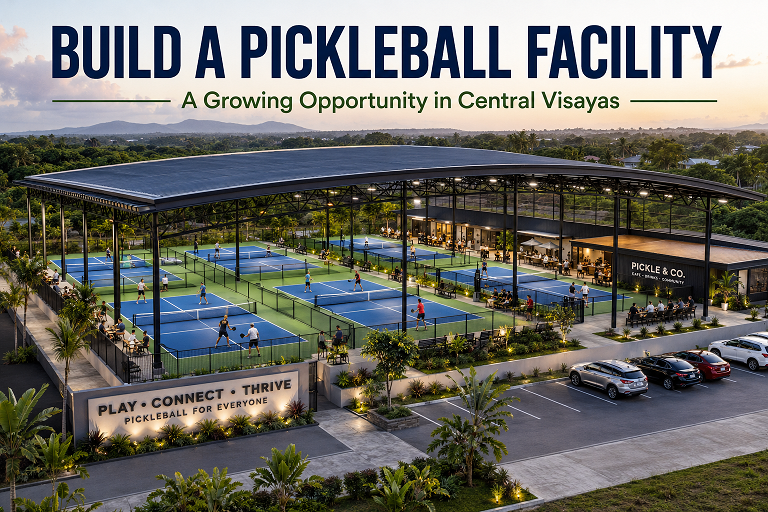
Pickleball is rapidly becoming one of the world’s fastest-growing recreational sports—and it presents an increasingly interesting business opportunity for property owners, entrepreneurs, resort developers and investors throughout Cebu Province and Central Visayas.
From growing residential communities and tourism destinations to resorts, subdivisions and emerging leisure hubs, the region has many of the ingredients needed to support the growth of pickleball.
But the opportunity isn’t simply about building a few courts.
The real opportunity is to create a well-designed pickleball destination that becomes part of the community.
And if you’re considering developing a pickleball facility, there is another important consideration:
A good pickleball facility starts with good court construction.
The quality of the court affects player experience, maintenance requirements, durability and ultimately the reputation of the facility.
Why Is Pickleball Becoming So Popular?
One of pickleball’s biggest advantages is that it is easy to start playing.
Compared with tennis, the smaller court, slower ball and smaller playing area make the sport relatively approachable for beginners.
You don’t need years of training before you can enjoy a game.
That opens pickleball to a remarkably broad market:
- Young adults
- Families
- Working professionals
- Recreational athletes
- Older adults
- Former tennis players
- Complete beginners
- Resort guests
- Corporate groups
- Local communities
This broad appeal is one of the reasons investors are beginning to look at pickleball as more than simply a recreational activity.
It can potentially become a commercial leisure business.
Pickleball Is a Social Sport
One of pickleball’s strongest advantages is its social nature.
Doubles play is extremely common, allowing four people to use one court.
Players can participate in:
- Open play
- Weekly leagues
- Tournaments
- Coaching sessions
- Corporate events
- Family activities
- Social nights
- Beginner sessions
The result is something particularly valuable to a business owner:
repeat customers.
A person who makes friends at your facility, joins a weekly league and becomes part of a pickleball group has a reason to keep coming back.
That is much more valuable than relying entirely on occasional walk-in customers.
Why Pickleball Can Be Attractive Compared With Other Sports
Pickleball has characteristics that make it particularly suitable for commercial recreation facilities.
| Factor | Pickleball | Tennis | Volleyball | Basketball |
| Beginner friendly | Very high | Moderate | Moderate | Moderate |
| Learning curve | Lower | Higher | Moderate | Moderate |
| Space requirements | Lower | Higher | Higher | Higher |
| Doubles/group play | Excellent | Excellent | Excellent | Excellent |
| Physical intensity | Adjustable | Higher | Higher | Higher |
| Social interaction | Very high | High | Very high | High |
| Casual play | Excellent | Good | Moderate | Good |
| Accessibility to older players | Excellent | More demanding | More demanding | More demanding |
Pickleball isn’t necessarily “better” than these sports.
Its advantage is that it can attract people who want exercise, competition and social interaction without the physical demands or learning curve associated with some other sports.
The Business Opportunity Is Bigger Than Court Rentals
An investor shouldn’t think:
“I’ll build courts and rent them by the hour.”
A better concept is:
Build a pickleball destination with multiple sources of revenue.
Potential revenue streams include:
Court rentals
Players pay by the hour or through booking packages.
Memberships
Monthly or annual memberships can create recurring revenue.
Open play
Players pay a session fee and participate in organized games.
Coaching
Lessons and clinics introduce beginners to the sport while generating additional revenue.
Leagues
Weekly leagues encourage customers to return regularly.
Tournaments
Tournaments can attract players from surrounding towns, cities and even neighboring islands.
Corporate events
Companies can rent multiple courts for team-building and recreational events.
Food and beverages
A café, restaurant, coffee bar or refreshment area can increase spending per visitor.
Pro shop
Paddles, balls, shoes, bags, clothing and accessories create another revenue opportunity.
Equipment rental
Beginners can rent paddles instead of purchasing equipment immediately.
The more successfully these activities are combined, the less dependent the business becomes on hourly court rentals alone.
Can Pickleball Have Good ROI?
It can—but there is no universal ROI figure.
The financial performance of a pickleball facility depends on:
- Land cost
- Construction cost
- Number of courts
- Court pricing
- Utilization
- Memberships
- Coaching
- Events
- Food and beverage
- Staffing
- Electricity
- Maintenance
- Competition
- Location
- Financing
One of the most important variables is court utilization.
For example, consider an illustrative eight-court facility charging an average realized rate of ₱450 per court-hour.
At five paid hours per court per day:
8 × 5 × ₱450 = ₱18,000 per day
That is approximately:
₱540,000 per month
in gross court-rental revenue if operating 30 days.
At seven paid hours per court per day:
8 × 7 × ₱450 = ₱25,200 per day
or approximately:
₱756,000 per month.
At nine paid hours:
approximately ₱972,000 per month.
These are illustrative gross rental figures—not profit projections.
The purpose is to demonstrate how dramatically utilization can affect the economics of the business.
And these figures don’t include memberships, coaching, tournaments, food and beverages, merchandise or corporate events.
Location Is More Important Than the Number of Courts
Whether you are considering:
- Cebu City
- Mandaue
- Lapu-Lapu and Mactan
- Consolacion
- Liloan
- Talisay
- Carcar
- Northern or Southern Cebu
- Bohol
- Panglao
- Tagbilaran
- Siquijor
- Dumaguete
- Other growing communities throughout Central Visayas
the same principle applies:
Don’t choose a location simply because land is available. Choose it because people will want to travel there regularly.
A strong site should ideally have:
- A substantial nearby population
- Residential communities
- Good road access
- Convenient parking
- Evening accessibility
- Nearby offices or commercial areas
- Hotels or resorts where applicable
- Limited direct competition—or an opportunity to differentiate
- Room for expansion
The ideal customer may be willing to drive 10–15 minutes for a good facility.
But the farther customers have to travel, the more important it becomes for the facility to offer something special.
Pickleball Can Work Particularly Well in Tourism and Resort Areas
Central Visayas has another potential advantage:
tourism.
A pickleball facility doesn’t necessarily have to depend entirely on permanent local residents.
In tourism-oriented areas, potential customers can include:
- Resort guests
- Hotel guests
- Foreign visitors
- Long-term residents
- Vacation-home owners
- Retirees
- Local residents
- Expatriate communities
- Corporate groups
- Wellness and fitness travelers
This creates opportunities for facilities integrated with:
resorts, hotels, residential developments, wellness destinations and mixed-use leisure projects.
Imagine a resort where guests can enjoy:
Beach + pool + restaurant + pickleball + fitness + social activities.
Pickleball can become another reason for guests to stay longer and spend more within the property.
How to Build a High-Quality Pickleball Court
A commercial pickleball court should not be treated simply as a concrete slab with painted lines.
The playing surface is a system consisting of the site preparation, drainage, structural base, concrete or asphalt surface, sport-surfacing system, line markings and net system.
USA Pickleball and the American Sports Builders Association publish construction guidance covering court design, surfacing, drainage and maintenance.
1. Start With Proper Site Preparation
Before concrete is poured, the site needs to be properly:
- Surveyed
- Graded
- Compacted
- Drained
- Prepared for the intended structural loading
This is particularly important in tropical locations where heavy rainfall can quickly expose drainage problems.
A beautiful court cannot compensate for a poorly prepared site.
Water that remains beneath or around the court can contribute to:
- Settlement
- Cracking
- Surface deterioration
- Algae and organic growth
- Blistering or peeling of coatings
Proper perimeter drainage and stormwater management should therefore be considered during site planning, not added as an afterthought.
2. Court Dimensions
The actual pickleball playing area is:
20 feet × 44 feet
or approximately:
6.10 m × 13.41 m.
However, players need additional space outside the painted playing lines.
USA Pickleball recommends approximately 30 × 60 feet as a minimum overall playing surface, while 34 × 64 feet is preferred where space permits.
That distinction is important when calculating how much land a commercial facility actually needs.
You also need to account for:
- Walkways
- Fencing
- Player circulation
- Seating
- Lighting
- Drainage
- Access between courts
- Safety clearances
For a multi-court commercial facility, these spaces should be incorporated into the master plan from the beginning.
3. The Court Should Be Properly Oriented
For outdoor courts, a generally north-south orientation is preferred where practical because it can reduce problems from players looking toward the sun.
For covered facilities, the building orientation can be optimized differently because roof structure and artificial lighting become more important.
4. Concrete or Asphalt Can Be Used as the Base
Outdoor pickleball courts can be constructed over either concrete or asphalt.
For a high-quality commercial facility, however, the base needs to be engineered and constructed specifically for the site and intended use.
The important issue isn’t simply:
“Concrete or asphalt?”
It is:
“Can the base remain stable, drain properly and provide a suitable surface for the sports coating over many years?”
For concrete construction, the design should address:
- Subgrade preparation
- Compaction
- Reinforcement
- Concrete strength
- Slab thickness
- Control joints
- Perimeter joints
- Curing
- Surface preparation
- Drainage
The exact structural specification should be determined by the project engineer based on soil conditions, loading, climate and site conditions rather than copied from a generic internet specification.
5. Drainage and Slope Are Critical
A pickleball court should not be perfectly flat like an indoor floor.
It needs a small, controlled slope so rainwater can leave the playing surface.
Industry guidance commonly uses approximately 0.83%–1.0% slope for hard courts, with USA Pickleball/ASBA guidance emphasizing proper slope and drainage.
A 1% slope means approximately:
1 inch of fall for every 10 feet
or about:
10 mm per metre.
The court should generally be designed with a consistent plane rather than creating random low spots or a poorly controlled crown.
The drainage strategy should also consider the surrounding property.
The objective is not simply to make water leave the court.
It is to make sure the water has somewhere appropriate to go.
6. The Top Surface Should Normally Be a Sports-Court Coating System
This is one of the most important technical points.
The top of a commercial pickleball court should generally not be ordinary concrete paint or ordinary epoxy floor paint.
A purpose-designed acrylic sports-court system is typically used.
USA Pickleball states that 100% acrylic coatings are recommended for pickleball and athletic courts. These systems can incorporate aggregate to provide appropriate texture, traction and playing characteristics.
A typical system may include:
Prepared concrete/asphalt base
↓
Surface repairs
↓
Acrylic resurfacer / leveling system
↓
Acrylic color coats
↓
Textured sports-court finish
↓
Pickleball playing lines
The exact number of coats and products depends on the manufacturer’s specification and the condition of the base.
7. Why Not Ordinary Epoxy Paint?
Epoxy has excellent applications in many industrial and commercial floors, but a pickleball court needs more than simply a hard, attractive coating.
The playing surface needs appropriate:
- Texture
- Traction
- Ball response
- Abrasion resistance
- UV resistance
- Flexibility
- Surface uniformity
A specialized acrylic sports-court system is designed specifically around these requirements.
For a commercial facility, the surfacing manufacturer and qualified sports-surface installer should specify the complete system rather than simply selecting an ordinary exterior paint.
8. Concrete Preparation Matters
Even the best acrylic coating cannot fix a badly constructed slab.
For example, SportMaster’s published technical guidance calls for new concrete to cure before surfacing and specifies surface preparation, vapor protection and drainage considerations. It also identifies approximately 1% slope for surface drainage.
This illustrates an important construction principle:
The coating is only as good as the substrate underneath it.
Cracks, depressions, contaminants and moisture problems need to be addressed before the surfacing system is installed.
9. Don’t Ignore Moisture
Central Visayas presents a different challenge from colder climates: heat, humidity and heavy rainfall.
Moisture management therefore deserves serious attention.
The court design should consider:
- Subgrade drainage
- Perimeter drainage
- Vapor protection
- Groundwater conditions
- Concrete curing
- Surface moisture
- Rain exposure
- Roof runoff
If moisture becomes trapped beneath an incompatible coating system, blistering, peeling and adhesion problems can occur.
Proper specification and installation are therefore essential.
10. The Playing Lines Need to Be Accurate
The playing lines should follow the official court dimensions.
The playing court is:
20 × 44 feet
with a 7-foot non-volley zone, commonly called the “kitchen,” on each side of the net.
The net is approximately:
36 inches high at the sidelines
and
34 inches at the center.
For a commercial facility, accurate layout matters.
Poorly positioned lines or an incorrectly installed net can immediately make a supposedly professional facility feel amateur.
Covered Pickleball Courts Require Additional Design Considerations
If you’re building a covered or indoor facility, the court itself is only part of the project.
The building should be designed around:
Clear height
Players need sufficient vertical clearance for high shots and lobs.
Lighting
Lighting should provide even illumination without creating glare or shadows that interfere with tracking the ball.
Ventilation
Central Visayas can become extremely hot inside a large enclosed structure.
Roof insulation
Reducing radiant heat from the roof can significantly improve player comfort.
Air movement
Large-volume fans and appropriate ventilation can help remove accumulated heat.
Acoustics
Multiple pickleball courts can generate significant noise.
Acoustic treatment should therefore be considered during building design.
Rain protection
Roof drainage and runoff should be designed so heavy rain doesn’t flood the playing area.
This is why a commercial pickleball facility should be designed as a sports building, rather than simply putting a roof over a concrete court.
Don’t Forget Fencing
Outdoor and semi-outdoor facilities commonly use fencing to keep balls within the playing area.
Fencing should be designed around:
- Ball containment
- Player safety
- Visibility
- Corrosion resistance
- Access gates
- Maintenance
- Wind exposure
For Central Visayas, corrosion resistance deserves particular attention, especially for properties near the sea.
Galvanized and appropriately coated metal components can help, but the specification should be selected according to the site’s exposure conditions.
Lighting Is Part of the Business Model
If your facility will operate in the evening, lighting isn’t an accessory.
It is part of the revenue-generating infrastructure.
Good sports lighting should provide:
- Consistent illumination
- Minimal glare
- Minimal shadows
- Appropriate color rendering
- Reliable switching/control
- Efficient energy consumption
- Proper positioning around the courts
The lighting design should be coordinated with the structural roof and electrical system before construction.
Think About Maintenance From Day One
A good pickleball facility should be designed for maintenance.
The surface should be regularly inspected for:
- Cracks
- Surface wear
- Standing water
- Algae
- Dirt
- Peeling
- Fading
- Drainage problems
Acrylic sports surfaces are relatively low-maintenance when properly installed and maintained, but they are not maintenance-free.
Proper maintenance can extend the useful life of the playing surface and help preserve the quality of the customer experience.
Don’t Underestimate Parking
Parking can make or break a recreational facility.
Consider an eight-court facility.
With four players per court, you could have:
32 players playing simultaneously.
Then add:
- Coaches
- Staff
- Spectators
- Tournament participants
- Café customers
- Family members
A busy facility can easily have dozens of people arriving and leaving within a relatively short period.
A property with excellent courts but inadequate parking can create a poor customer experience.
For this reason, a slightly less central property with excellent access and parking may sometimes be more attractive than an expensive prime commercial location.
Pickleball Can Work Particularly Well in Tourism and Resort Areas
Central Visayas has another potential advantage:
tourism.
A pickleball facility doesn’t necessarily have to depend entirely on permanent local residents.
In tourism-oriented areas, potential customers can include:
- Resort guests
- Hotel guests
- Foreign visitors
- Long-term residents
- Vacation-home owners
- Retirees
- Local residents
- Expatriate communities
- Corporate groups
- Wellness and fitness travelers
This creates opportunities for facilities integrated with:
resorts, hotels, residential developments, wellness destinations and mixed-use leisure projects.
Imagine a resort where guests can enjoy:
Beach + pool + restaurant + pickleball + fitness + social activities.
Pickleball can become another reason for guests to stay longer and spend more within the property.
How Many Courts Should You Build?
More courts don’t automatically mean more profit.
An investor might be tempted to build 12, 16 or even more courts immediately.
But additional courts also mean additional capital investment.
For a new facility, a phased development strategy may be worth considering.
For example:
Phase 1: 6–8 courts
Then design the property so that additional courts can be added later.
This gives the business an opportunity to prove:
- Local demand
- Peak-hour utilization
- Pricing
- Membership demand
- Coaching demand
- Tournament demand
- Food and beverage potential
before committing additional capital.
Turn the Facility Into a Pickleball Social Club
The most successful facility may not simply be the one with the best courts.
It may be the one where people want to spend time.
Consider including:
- Comfortable seating
- Clean restrooms
- Showers
- Changing rooms
- Drinking water
- Café
- Restaurant
- Wi-Fi
- Pro shop
- Social areas
- Good lighting
- Comfortable temperatures
- Convenient parking
This transforms the concept from:
“pickleball courts”
into:
“a place where people meet, play, eat and socialize.”
Create a Reason to Come Back Every Week
A facility can create recurring demand through a structured weekly program.
For example:
Monday: Beginner Night
Tuesday: Women’s League
Wednesday: Open Play
Thursday: Corporate Night
Friday: Social Night
Saturday: Tournament
Sunday: Family Day
The exact schedule will depend on the market.
The important concept is that the facility becomes part of people’s weekly routine.
That is how a recreational facility can build a loyal customer base.
Pickleball Can Also Complement Other Businesses
Pickleball doesn’t have to be a standalone development.
It can potentially be incorporated into:
Resorts
Add an active recreational attraction for guests.
Residential developments
Create a community amenity and potentially increase the appeal of the development.
Hotels
Provide another activity for guests.
Mixed-use developments
Combine sports, food, retail and entertainment.
Wellness destinations
Combine pickleball with fitness, health and recreation.
Commercial developments
Convert underutilized space into an active leisure destination.
Tourism properties
Create an additional attraction for visitors.
This opens the opportunity to developers who aren’t necessarily looking to build a standalone sports facility.
Construction Design Can Directly Affect the Business
A pickleball facility is not simply a concrete slab with painted lines.
The building and court system should be planned around:
- Court dimensions
- Playing clearances
- Surface performance
- Drainage
- Lighting
- Roof structure
- Ventilation
- Heat management
- Acoustics
- Electrical requirements
- Plumbing
- Restrooms
- Showers
- Parking
- Future expansion
The facility should be designed around both the player experience and the business model.
A beautiful building that is expensive to operate can hurt the investment.
Likewise, a cheap facility that provides an uncomfortable playing environment may struggle to attract repeat customers.
The goal is to find the right balance between:
construction cost + durability + comfort + operating cost + customer experience.
Before You Build, Do the Numbers
Before purchasing property or starting construction, prepare a proper feasibility study.
Calculate your:
Capital investment
- Land or lease
- Site development
- Building
- Roofing
- Court construction
- Lighting
- Electrical
- Plumbing
- Parking
- Drainage
- Furniture
- Equipment
- Permits
- Professional fees
Operating costs
- Staff
- Electricity
- Water
- Internet
- Cleaning
- Security
- Maintenance
- Marketing
- Insurance
- Financing
Revenue
- Court rentals
- Memberships
- Open play
- Coaching
- Leagues
- Tournaments
- Corporate events
- Food and beverages
- Merchandise
- Equipment rental
Then calculate:
Break-even point
Monthly operating profit
Annual cash flow
Return on investment
Payback period
Most importantly, test the project under different utilization scenarios.
A good investment should not depend entirely on every court being occupied from morning until night.
Central Visayas May Offer a Particularly Interesting Opportunity
The region has a combination of characteristics that can support recreational businesses:
Growing communities
Tourism
Residential development
Resort development
Increasing interest in fitness and recreation
Large urban centers
Island destinations
Foreign residents and long-term visitors
Growing leisure spending
These characteristics mean pickleball doesn’t necessarily have to be limited to the largest city.
A well-positioned facility in a growing community, resort destination or residential area could potentially succeed by becoming the local hub for pickleball and social recreation.
The Opportunity Isn’t Just to Build Courts
The biggest mistake would be to look at pickleball simply as:
“a sport that needs courts.”
Look at it instead as:
“a growing recreational community that needs places to play, socialize, compete and spend time.”
That creates a much bigger business opportunity.
The facility could become:
a sports club
a social destination
a café
a tournament venue
a coaching center
a corporate event venue
a resort amenity
a community gathering place
—or all of these at once.
Thinking About Building a Pickleball Facility?
If you own land anywhere in Cebu Province or Central Visayas, have an underutilized warehouse or commercial property, are developing a resort, or are considering a new recreational investment, now may be an excellent time to investigate what could be built.
You don’t necessarily need to start with 12 or 16 courts.
The right project might be a small community facility, a 6–8 court social club, a larger tournament venue, or a resort-integrated pickleball destination.
The key is to match the facility to the market.
Before construction begins, the site, number of courts, layout, building design, parking, amenities, ventilation, future expansion and projected operating costs should all be considered together.
And most importantly, the courts themselves need to be built correctly.
A quality pickleball court starts below the visible playing surface—with proper site preparation, drainage, a stable base, accurate grading, appropriate concrete or asphalt construction and a purpose-designed acrylic sports surfacing system.
The lines and net are only the final part of the job.
Have a property you’re considering for pickleball?
Let’s look at what could realistically be built on it.
Thinking about developing a pickleball facility in Cebu, Bohol, Siquijor, Negros Oriental or elsewhere in Central Visayas?
A good pickleball project starts with good planning—not simply with pouring concrete.
Let’s discuss your property, your vision and what type of pickleball facility could make the most sense for your investment.
Leave a Reply