If you are planning to build a house in the Philippines, one of the first questions you will probably ask is:
“How much does it cost to build a house per square meter?”
The answer is not as simple as giving one price.
In 2026, the cost of building a home in the Philippines can vary enormously depending on the location, structural system, size, architectural design, quality of materials, labor, and level of finishing.
A basic house may be built for a relatively modest amount, while a high-end custom home can cost several times more per square meter.
This guide explains the different construction price levels and, more importantly, what you should expect to get at each level.
Why Construction Prices Can Be So Different
Two houses can have exactly the same floor area but dramatically different construction costs.
For example, a 100-square-meter house could be a simple two-bedroom home with basic finishes, or it could be a high-end architectural residence with premium windows, custom cabinetry, imported tiles, smart-home technology and sophisticated lighting.
Both are 100 square meters.
But they are very different products.
Construction costs are affected by factors such as:
- Structural design
- Foundation requirements
- Concrete and reinforcement
- Wall system
- Roofing system
- Windows and doors
- Flooring
- Kitchen cabinetry
- Bathroom fixtures
- Electrical system
- Plumbing
- Air-conditioning provisions
- Insulation
- Architectural details
- Landscaping
- Built-in furniture
- Smart-home technology
- Site conditions
- Location
- Labor costs
- Contractor overhead and profit
This is why simply asking for the cheapest price per square meter can sometimes lead to an unfair comparison.
What Does the Philippine Statistics Authority Say?
The Philippine Statistics Authority (PSA) provides official statistics based on construction reported through approved building permits.
For May 2026, the PSA reported an average construction cost of ₱14,081.64 per square meter for residential construction nationwide.
However, this should not automatically be interpreted as the price a homeowner should expect to pay for a complete, professionally designed and finished house.
The PSA figure is based on reported construction values from approved building permits. It can therefore be very different from the price quoted by a contractor for a turnkey home with architectural design, project management, higher-grade finishes, contractor overhead, profit and other project-specific requirements.
In fact, official PSA data also show considerable differences between locations and types of residential construction. For example, Eastern Visayas recorded an average residential construction cost of ₱12,320 per square meter in the first quarter of 2026, while individual provinces can be considerably higher or lower.
So when comparing contractor quotations, do not compare a contractor’s complete-house quotation directly with a PSA statistical average.
They are measuring different things.
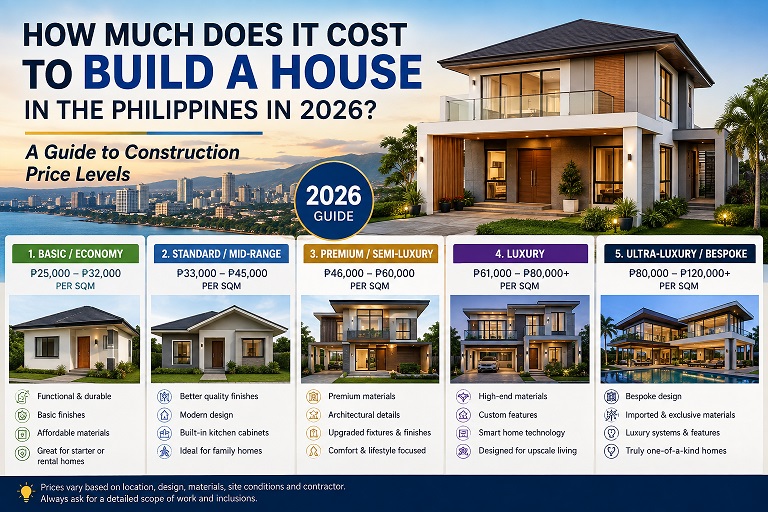
A Practical 2026 Construction Price Guide
For homeowners looking at actual finished residential construction, it is more useful to think in terms of construction quality levels.
A practical market-oriented guide is:
| Construction Level | Approximate Price Per SQM |
| Basic / Economy | ₱25,000–₱32,000 |
| Standard / Mid-Range | ₱33,000–₱45,000 |
| Premium / Semi-Luxury | ₱46,000–₱60,000 |
| Luxury | ₱61,000–₱80,000+ |
| Ultra-Luxury / Bespoke | ₱80,000–₱120,000+ |
These are planning ranges, not fixed national rates.
Actual quotations can be lower or higher depending on the project.
Let’s look at what each level generally provides.
Level 1: Basic / Economy
Approximately ₱25,000–₱32,000 per square meter
The Basic or Economy level is designed primarily around functionality, durability and affordability.
It is suitable for homeowners who want a decent house without spending heavily on architectural details and premium finishes.
Typical features
Structure
- Reinforced concrete foundation
- Reinforced concrete columns and beams
- Conventional concrete slab
- Standard reinforcement
- CHB or other conventional wall construction
- Conventional roofing
Exterior
- Simple architectural design
- Plastered and painted walls
- Standard roofing
- Basic aluminum windows
- Simple exterior doors
- Basic steel gate
Interior
- Standard ceramic tiles
- Basic painted walls
- Simple ceiling
- Standard flush doors
- Basic kitchen counter
- Basic bathroom fixtures
Electrical and plumbing
- Standard electrical system
- Basic lighting
- Standard electrical outlets
- Conventional plumbing
- Basic bathroom fixtures
Who is this level for?
This level can work well for:
- Starter homes
- Rental properties
- Simple family homes
- Budget-conscious homeowners
- Investment properties
- Provincial housing projects
The priority here is getting a functional and durable house without paying for unnecessary luxury features.
Level 2: Standard / Mid-Range
Approximately ₱33,000–₱45,000 per square meter
For many families, this is the sweet spot between affordability and quality.
The house begins to look and feel substantially more upscale than a basic construction project.
Typical features
Structure
- Reinforced concrete structural system
- Better waterproofing
- Improved roofing details
- Better-quality construction materials
- Provisions for modern utilities
Exterior
- Modern façade
- Better-quality windows
- Aluminum-framed windows
- Architectural wall accents
- Stone or wood-look features
- Better entrance door
- Improved exterior finishes
Interior
- Better ceramic or porcelain tiles
- Gypsum-board ceilings
- Architectural lighting provisions
- Better interior paint
- Improved doors
- Built-in kitchen cabinets
- Granite or engineered-stone countertops
- Better bathroom finishes
Electrical
- More electrical outlets
- Better lighting layout
- Dedicated circuits for appliances
- Air-conditioning provisions
- Internet/data provisions
- CCTV provisions
Plumbing
- Better-quality plumbing fixtures
- Improved drainage
- Water-heater provisions
- Better bathroom finishes
- Improved waterproofing
Who is this level for?
This is an excellent level for:
- Permanent family homes
- OFW families
- Professionals
- Retirees
- Foreign homeowners
- Build-and-sell projects
- Homeowners who want a modern but practical house
For many Cebu homeowners, this is likely to be one of the most attractive segments.
Level 3: Premium / Semi-Luxury
Approximately ₱46,000–₱60,000 per square meter
At this level, the emphasis moves beyond simply building a house.
You are beginning to build a designed lifestyle environment.
The architectural appearance becomes more important, and better-quality materials and systems begin to appear throughout the house.
Typical features
- Premium porcelain tiles
- Large-format tiles
- Quartz or granite countertops
- Higher-quality aluminum windows
- Larger glass openings
- Premium doors
- Custom kitchen cabinetry
- Built-in wardrobes
- Feature walls
- Architectural ceilings
- Decorative lighting
- More sophisticated façade
- Premium bathroom fixtures
- Glass shower enclosures
- Improved waterproofing
- Better insulation
- Solar-ready electrical system
- CCTV system
- Video doorbell
- Structured internet/data wiring
- Smart switches
- Motorized gate
- Improved landscaping
At this level, architectural design itself becomes a significant part of the value.
You are not simply paying for more concrete and steel.
You are paying for a better-designed and better-finished home.
Level 4: Luxury
Approximately ₱61,000–₱80,000+ per square meter
Luxury construction is for homeowners who want something substantially beyond a conventional house.
This is where customized architecture, premium materials and sophisticated systems become much more common.
Architectural features may include
- Highly customized façade
- Large glass openings
- Dramatic entrance
- Double-height spaces
- Cantilevered architectural elements
- Large balconies
- Architectural concrete
- Premium exterior materials
- Extensive façade detailing
Interior features may include
- Natural stone
- Marble
- Imported tiles
- Premium hardwood
- Custom millwork
- Full-height cabinetry
- Designer kitchen
- Walk-in closets
- Hotel-style bathrooms
- Custom staircases
- Feature lighting
Technology and building systems may include
- Smart-home automation
- Automated lighting
- Motorized curtains
- Smart locks
- Advanced security systems
- Home theater
- Whole-house networking
- Solar power
- Battery backup
- Generator
- Advanced air-conditioning systems
At this level, the homeowner is usually paying as much for design, customization and quality of execution as for the raw building materials.
Level 5: Ultra-Luxury / Bespoke
Approximately ₱80,000–₱120,000+ per square meter
At this point, it becomes difficult to describe the project simply as a “house package.”
It is more appropriate to think of it as a custom architectural residence.
The homeowner may want highly specialized materials, imported products, custom furniture and sophisticated building systems.
Possible features include
- Imported marble
- Natural stone façades
- Premium European-style windows and doors
- Full-height glazing
- Custom furniture
- Designer kitchen
- Custom cabinetry
- Custom staircase
- Infinity pool
- Resort-style landscaping
- Outdoor entertainment areas
- Full smart-home automation
- Home theater
- Wine room
- Elevator
- Generator
- Solar and battery system
- Premium air-conditioning
- Advanced security system
- High-end bathroom fixtures
At this level, the price per square meter can become misleading.
A relatively small luxury house with imported materials and sophisticated equipment may cost more per square meter than a much larger residence.
Why the Cheapest Price Per Square Meter Isn’t Always the Best Deal
Suppose Contractor A offers to build a house for ₱30,000 per square meter.
Contractor B quotes ₱40,000.
At first glance, Contractor A appears to be ₱10,000 per square meter cheaper.
But what if Contractor A’s price excludes:
- Kitchen cabinets
- Certain lighting fixtures
- Air-conditioning provisions
- Better windows
- Landscaping
- Waterproofing upgrades
- Custom ceilings
- Certain electrical works
- Some plumbing fixtures
- Contractor overhead
- Other finishing items
Meanwhile, Contractor B may include many of these items.
The ₱40,000 house could therefore actually provide better value.
This is why homeowners should ask:
“What exactly is included in your price per square meter?”
rather than simply:
“How much is your price per square meter?”
What About Labor?
Labor is another major reason construction quotations can vary.
A contractor’s price must account for more than the wages paid to individual workers.
Depending on the project, the overall construction price may need to cover:
- Skilled workers
- Helpers
- Foreman
- Site supervision
- Project management
- Equipment
- Transportation
- Temporary facilities
- Contractor overhead
- Safety requirements
- Wastage
- Administration
- Contractor profit
A quotation that appears extremely cheap may simply be leaving some of these costs outside the advertised price.
For a homeowner, the important question is not whether labor is “cheap.”
The important question is whether the contractor has properly allowed for the labor and supervision necessary to deliver the promised quality.
What About ICF Construction?
Another option increasingly worth considering is Insulated Concrete Form (ICF) construction.
ICF uses insulating forms that remain in place around reinforced concrete walls.
Instead of looking at ICF purely as another wall material, homeowners should consider its potential performance advantages.
Depending on the specific ICF system and overall building design, ICF construction can provide:
- Excellent thermal insulation
- Reduced heat transfer
- Improved indoor comfort
- Potential energy savings
- Increased wall mass
- Improved sound insulation
- Strong reinforced concrete wall construction
- Good resistance to severe weather when properly engineered
This can be particularly interesting in the Philippines, where homeowners deal with high temperatures, humidity, heavy rain, storms and noisy urban environments.
However, the performance of the entire house still depends on the windows, doors, roof, ventilation, air-conditioning, orientation and overall building design.
ICF is therefore not simply a magic material that makes every house automatically energy-efficient.
It works best when it is part of a properly designed high-performance home.
ICF and the Future of Philippine Housing
For Cebu and other parts of the Visayas, high-performance construction may become increasingly attractive.
A homeowner may be willing to spend more initially if the house offers better long-term comfort and durability.
For example, an ICF home could be positioned in the Premium or High-Performance market rather than competing directly against the cheapest conventional houses.
Instead of asking:
“Why does this house cost more?”
the discussion becomes:
“What additional performance am I receiving for the additional investment?”
That is a much more useful way to evaluate construction.
How Much Would a 100-Square-Meter House Cost?
Using the practical market ranges above, a 100-square-meter house could roughly look like this:
| Level | Approx. Cost for 100 sqm |
| Basic | ₱2.5M–₱3.2M |
| Standard | ₱3.3M–₱4.5M |
| Premium | ₱4.6M–₱6.0M |
| Luxury | ₱6.1M–₱8.0M+ |
| Ultra-Luxury | ₱8.0M–₱12.0M+ |
These are construction planning figures only.
They do not automatically mean that every project at that price will include the land, professional fees, permits, financing costs, landscaping, pools, furniture or other special requirements.
A proper project quotation should clearly state what is included and excluded.
What Is Usually NOT Included in a Basic Construction Price?
This is one of the most important questions to ask before signing a contract.
Depending on the contractor and quotation, the following may be separate:
- Lot acquisition
- Architectural and engineering professional fees
- Building permits
- Government fees
- Geotechnical investigation
- Survey
- Major site development
- Retaining walls
- Extensive excavation
- Landscaping
- Swimming pool
- Solar panels
- Generator
- Major appliances
- Furniture
- Curtains
- Interior decoration
- Special imported materials
- Financing costs
Always ask the contractor for a detailed scope of work and specifications.
Construction Cost Per Square Meter Should Only Be Your Starting Point
The price per square meter is useful because it gives homeowners a quick way to estimate the size of their investment.
But it should never be the only basis for choosing a contractor.
A good construction comparison should consider:
1. Specifications
What materials are actually being used?
2. Scope of Work
What exactly is included?
3. Structural System
What kind of foundation, walls, beams, columns and roof are being provided?
4. Finishes
What grade of tiles, doors, windows, cabinets and bathroom fixtures are included?
5. Workmanship
Who will actually build the house?
6. Supervision
Is there qualified site supervision?
7. Contract
Are payment schedules, completion requirements and responsibilities clearly documented?
8. Warranty
What happens if defects appear after turnover?
The Bottom Line
There is no single “correct” construction price per square meter in the Philippines.
For 2026, a practical way to think about the market is:
₱25,000–₱32,000/sqm — Basic/Economy
₱33,000–₱45,000/sqm — Standard/Mid-Range
₱46,000–₱60,000/sqm — Premium/Semi-Luxury
₱61,000–₱80,000+/sqm — Luxury
₱80,000–₱120,000+/sqm — Ultra-Luxury/Bespoke
But these numbers are only useful when you understand what is actually included in each level.
The best house is not necessarily the cheapest house.
And the most expensive house is not necessarily the best house.
The real objective should be to find the right balance between structural quality, workmanship, design, durability, comfort, energy efficiency, finishes and budget.
For homeowners in Cebu and throughout the Philippines, getting a detailed scope of work and comparing contractors based on what they actually deliver—not simply their advertised price per square meter—is one of the most important steps toward getting good value from a construction project.
Planning to Build in Cebu?
Whether you are building a modest starter home, a modern family residence, a premium home or a custom luxury property, the first step is to establish your desired quality level and budget.
Once you know whether you are targeting the Economy, Standard, Premium, Luxury or Ultra-Luxury category, it becomes much easier to determine the appropriate floor area, specifications and construction system.
For homeowners planning a project in Cebu, comparing qualified contractors and requesting a detailed quotation can help you make a much more informed decision before construction begins.
Top Cebu Contractors is designed to help homeowners explore construction options and find contractors and construction professionals for projects in Cebu and beyond.
Leave a Reply