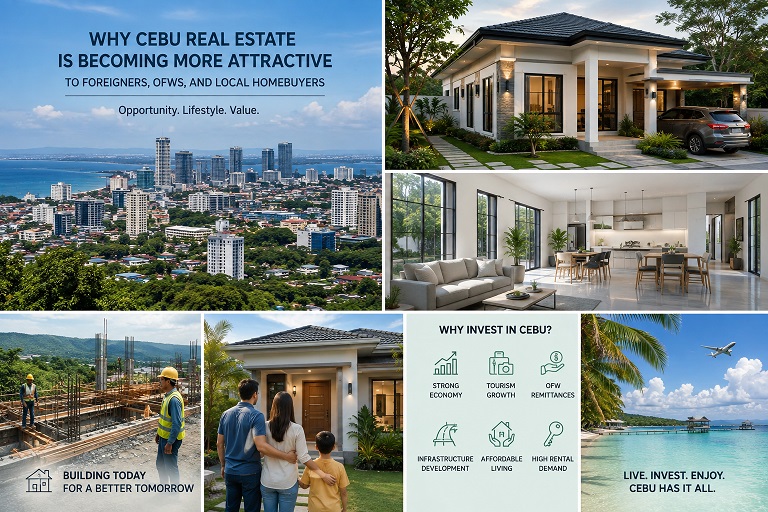
Cebu has long been one of the Philippines’ most important business and tourism destinations. Today, it is also becoming increasingly attractive as a place to live, invest, build, and own property.
From the continued expansion of business districts and infrastructure to tourism, overseas Filipino worker (OFW) remittances, and growing interest from international visitors and investors, several forces are coming together to support Cebu’s residential property market.
For property investors and aspiring developers, this raises an important question:
Is Cebu becoming a good place to build and sell residential properties?
The answer appears increasingly positive—but success depends on choosing the right location, price point, design, and target market.
Cebu’s Property Market Continues to Show Strong Demand
Cebu remains one of the strongest property markets outside Metro Manila. Recent market reports indicate continued demand across residential, office, hospitality, and mixed-use developments.
Colliers Philippines has described Cebu as a leading property market in the Visayas and Mindanao, supported by OFW remittances, business-process outsourcing, tourism, infrastructure development, and continuing investor interest.
The residential market is particularly interesting because demand is not coming from just one group.
Today’s Cebu property market includes:
- Filipino families looking for their first or next home
- OFWs investing their earnings back home
- Local professionals and entrepreneurs
- Investors purchasing properties for rental income
- Retirees and returning Filipinos
- Foreign residents and long-term visitors
- International investors participating in eligible property investments
This diversity makes Cebu different from markets that depend almost entirely on one type of buyer.
Why Are Foreigners Interested in Cebu?
One of the reasons Cebu attracts international residents and visitors is relatively simple:
Their purchasing power can go further in the Philippines.
Someone earning in U.S. dollars, Canadian dollars, Australian dollars, euros, pounds, or other stronger currencies may find many everyday expenses in the Philippines comparatively affordable.
But affordability alone is not enough to attract people to a city.
Cebu offers something more important: a combination of affordability and lifestyle.
Cebu provides access to international air travel, beaches and resort destinations, restaurants, shopping, healthcare, universities, business districts, telecommunications, and a large English-speaking population.
The combination makes Cebu attractive not only as a tourist destination but also as a place where foreigners can spend extended periods of time or establish a longer-term lifestyle.
The appeal is particularly evident in tourism-oriented areas such as Mactan and Lapu-Lapu, where residential and leisure developments continue to attract both local and foreign interest. Recent Colliers reporting has highlighted strong demand for leisure-oriented residential projects in Cebu and Mactan.
But Foreigners Are Not the Only Opportunity
It would be a mistake for a property developer to think:
“Foreigners are coming to Cebu, so I should build houses specifically for foreigners.”
The opportunity is much bigger than that.
Foreigners generally face restrictions on owning land in the Philippines, which means a developer of house-and-lot properties should not depend entirely on foreign buyers.
Instead, foreign residents and visitors can represent an important rental and lifestyle market, while Filipinos and OFWs remain a major potential market for home ownership.
This distinction is important.
A well-designed house in Cebu can potentially appeal to:
A Filipino family looking for a permanent home.
An OFW looking for an investment.
A returning Filipino who wants a modern home.
A foreign resident looking for a long-term rental.
One property can therefore appeal to several markets.
OFWs Remain a Major Force in Cebu Housing
Overseas Filipino workers have long played an important role in Philippine real estate.
Their earnings are frequently converted into long-term investments such as houses, lots, condominiums, and businesses.
Recent reports indicate that the ₱3 million to ₱6 million housing segment is particularly important to OFW buyers in Cebu, while limited new housing supply is making it more difficult for some buyers to find affordable options.
This creates an interesting opportunity for smaller developers.
Instead of attempting to compete directly with luxury developers, there may be significant potential in producing well-designed, properly constructed homes at attainable prices.
The Opportunity for Build-and-Sell Developers
Build-and-sell is relatively straightforward in concept:
Acquire land → design → construct → market → sell → reinvest the capital.
The difficult part is making sure the numbers work.
A profitable project begins with the land.
Buying the wrong property at the wrong price can destroy your margin before construction even begins.
The developer must consider:
- Land acquisition cost
- Construction cost
- Architectural and engineering fees
- Permits and approvals
- Site development
- Utilities
- Financing costs
- Construction contingencies
- Marketing and brokerage
- Taxes
- Holding costs
- Expected selling price
The goal is not simply to build a beautiful house.
The goal is to build a beautiful house that the market is willing to pay for.
Why Mid-Market Housing May Be Particularly Interesting
Current market data suggests that affordability remains one of the strongest drivers of residential demand.
Colliers reported that economic and lower-middle-income house-and-lot projects accounted for a significant portion of Cebu’s 2025 take-up, while the ₱2.5 million to ₱7 million range represented a large share of condominium demand.
More recent 2026 market observations likewise identify middle-income and economic housing as some of the strongest practical segments of Cebu’s residential market.
This suggests an important lesson:
The biggest opportunity may not necessarily be luxury housing.
It may be creating homes that provide substantially better design, construction quality, and livability without pushing the price beyond what ordinary buyers can afford.
Build Better, Not Simply Bigger
Today’s homebuyer is becoming more sophisticated.
A house does not necessarily need to be enormous to be attractive.
A 70–100 square meter house can be highly desirable if it has:
- A functional floor plan
- Good natural lighting
- Proper ventilation
- Quality waterproofing
- Well-designed bathrooms
- A modern kitchen
- Adequate storage
- A comfortable living area
- Parking
- Reliable utilities
- Fiber-internet readiness
- Solar-readiness
- Good security
- Attractive landscaping
Good architecture can make a relatively modest house feel significantly more valuable.
This is particularly important in a competitive market where buyers are comparing not only floor area but also quality and overall value.
Location May Matter More Than Luxury
For a build-and-sell project, location should be considered before architectural design.
A moderately priced house in the right location can be easier to sell than a luxury house in an inconvenient location.
Potential growth areas around Metro Cebu include established residential areas as well as developing corridors in places such as Consolacion, Liloan, Minglanilla, Cordova, and parts of Lapu-Lapu City, depending on the specific project and infrastructure surrounding the site. Current market outlooks point toward continued expansion into Metro Cebu’s outer residential corridors as land becomes more limited in established areas.
The important question is not simply:
“Is this land cheap?”
It is:
“Will people want to live here five or ten years from now?”
Cebu’s Infrastructure Is Expanding the Residential Opportunity
Infrastructure can change the value proposition of an entire area.
Improved roads, bridges, public transportation, business districts, airports, schools, commercial developments, and employment centers can make previously less attractive locations considerably more desirable.
Cebu continues to benefit from major infrastructure projects and expanding economic activity, while the growth of business-process outsourcing and other services continues to support employment and housing demand.
For developers, this means that identifying tomorrow’s residential locations can sometimes be more profitable than simply following today’s most expensive neighborhoods.
The Foreign-Rental Opportunity
There is another strategy worth considering.
Instead of immediately selling every property, a developer could consider retaining selected properties as rental investments.
A well-located home can potentially appeal to:
- Foreign retirees
- Long-term foreign visitors
- Expatriate workers
- Returning Filipinos
- BPO professionals
- Local executives
- Families relocating to Cebu
This creates a different investment model:
Build → Rent → Generate income → Appreciate → Sell when appropriate.
It can provide an alternative exit strategy when market conditions are not ideal for an immediate sale.
Cebu Is Not a Guaranteed Property Gold Mine
Despite the positive outlook, investors should remain realistic.
Property development carries significant risks.
Land prices can be too high.
Construction costs can increase.
Interest rates can affect buyers’ ability to finance homes.
Permitting and regulatory requirements can delay projects.
Poorly chosen locations can leave properties difficult to sell.
And an attractive house does not automatically mean a profitable development.
Recent industry reports have also pointed to delays in Licenses to Sell as a constraint on new residential supply, demonstrating that regulatory and project-execution considerations are important parts of property development.
The best developers therefore do not simply ask:
“What can we build?”
They ask:
“What does the market need, where does it need it, and what price can buyers realistically afford?”
The Future of Cebu Housing
Cebu’s long-term residential story is being supported by several different forces: tourism, OFW remittances, business expansion, infrastructure development, population growth, and continuing interest from local and international investors.
That does not mean every property will be profitable.
It means that there is a strong underlying market for developers who understand their buyers and control their costs.
The opportunity may be especially attractive for smaller construction and development companies that can move quickly, identify suitable land, design efficiently, and provide better construction quality without the overhead of a very large developer.
Building Cebu’s Next Generation of Homes
The future of Cebu real estate may not belong exclusively to giant condominium towers or luxury subdivisions.
There is also a growing opportunity for well-designed, practical, high-quality homes that ordinary Filipino families, OFWs, investors, and international residents can appreciate.
For a developer, the formula is relatively simple:
Good location + sensible price + excellent construction + thoughtful design + disciplined costing = a stronger property investment.
Cebu continues to evolve.
As more people come to Cebu to work, study, invest, retire, visit, and build their lives, the demand for quality housing will continue to evolve with them. For those willing to study the market carefully and build for real demand rather than speculation, Cebu may offer one of the Philippines’ most interesting opportunities for residential property development.
Leave a Reply